Tuesday, December 6, 2011
A surprising encounter
Monday, December 5, 2011
A typical day in Leighton’s life
measures the depth of the ocean) and the two keel-ADCPs (that measure the speed of the currents).
| Leighton's corner |
When he wakes up, he first checks his maintenance planning (a list of things or instruments on board that need to be checked on that day) and sorts that out.
He then shows up in the main lab ... and there, scientists, technicians, the master, the chief scientist, seamen, jump him with problems. "Leighton my computer doesn’t work. Leighton, the SBP120 is off. Leighton internet is slow today!"
Before noon he will probably go to the top of the mast to fix the antenna, produce maps of the seafloor and check the met system that records different meteorological parameters (temperature of the sea water, speed of the wind, air temperature, etc).
While the ROV is in the water in the afternoon he will check that the USBL system (that records the location of the robot) is acquiring good data. Yes, one very important thing Leighton does is to make sure that the science GPS is working so that we can then locate our collection data for further studies.
He also makes sure that every single datum is recorded and saved properly to be sure that we will have access to all this information while working on the cruise results later on.
The one thing Leighton hasn’t done is get a haircut before leaving ... and now he is complaining all the time!
Sunday, December 4, 2011
Work had to stop for a while …
… as we have been encountering bad sea conditions since yesterday. We had Force 9 on the Beaufort scale of wind force (see blog post 17 Nov) yesterday afternoon and the surface of the sea was covered with spindrifts.
The ship instrument at the top of the mast (34m above the waterline) registered gusts of wind up to 60.7 knots (110 km/h).
Moving around in the ship becomes difficult, we have to keep ‘one hand for the ship’ (which means do not walk with both hands carrying something, but keep one hand free to hold in case of strong wave). It gives you the feeling of being drunk - without a drop of alcohol! - while trying to walk in a straight line.
Climbing the stairs is a tricky exercise not to mention trying to sleep while rolling from one side of your bed to the other!
Every single object on board has to be properly stored and secured to prevent any dangerous falls.
Cupboard doors and drawers are equipped with a lock which prevents them from opening inadvertently.

Hopefully the weather is improving and the wind is dying down gently … we should be able to resume work in the next few hours.
The ship instrument at the top of the mast (34m above the waterline) registered gusts of wind up to 60.7 knots (110 km/h).
| 31.1 is the current wind speed in knots and 60.7 is the maximum value recorded yesterday. 202.5 is the heading of the ship at this moment. |
Moving around in the ship becomes difficult, we have to keep ‘one hand for the ship’ (which means do not walk with both hands carrying something, but keep one hand free to hold in case of strong wave). It gives you the feeling of being drunk - without a drop of alcohol! - while trying to walk in a straight line.
Climbing the stairs is a tricky exercise not to mention trying to sleep while rolling from one side of your bed to the other!
Every single object on board has to be properly stored and secured to prevent any dangerous falls.
Cupboard doors and drawers are equipped with a lock which prevents them from opening inadvertently.
Hopefully the weather is improving and the wind is dying down gently … we should be able to resume work in the next few hours.
Saturday, December 3, 2011
Middle of what?
It’s time to pause for breath and give a brief overview of the work that is being done on board.
We have been exploring ‘Middle of What’ seamount for three days now. This is a smaller than ‘Coral’, but larger than Melville bank, which we visited last month. Strong currents at depth have made exploration more difficult using our underwater vehicles (ROV Kiel6000 and Hybis).
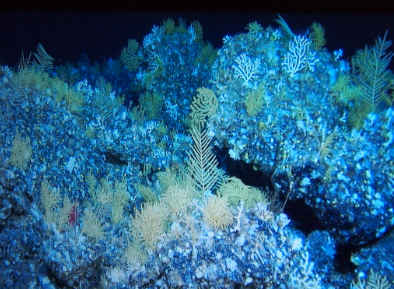
‘Middle of What’ seamount is crossed by a fault line and reveals quite steep slopes, cliffs and cone features that are possibly underwater volcanoes. Its summit is at 1,000m depth. Unfortunately, most of the more accessible area on the main seamount has been flattened by trawls and is mostly devoid of complex framework. But, in some areas, we have seen amazing coral reefs and coral gardens (some bamboo corals were up to 3m height!), orange lobsters and different fish species including many small energetic sharks.
We have completed several explorations of the site and Clare was, as usual, scrutinizing the screen whilst the robot is lowered through the water column looking for jellyfish (see blog post of 14 Nov). These dives allow us to explore the deep-sea habitats by watching the live images on the main lab screens. We are doing several transects to cover the largest area possible and sample the seabed fauna.
Everyone is concentrated on the samples: Michelle is examining corals (see blog post 22 Nov); Tim, Peter and their colleagues are sorting the sediments that have been cored (25 Nov); David is identifying the pycnogonids (sea spiders) that we find on a coral (2 Dec); and so on …
Each animal and each sample is preserved in alcohol or formalin to allow taxonomic analysis later on.
The whole night of bathymetric survey (see blog post of 16 Nov) was well worth it as new maps of the relief of the seabed have been compiled.
We have been exploring ‘Middle of What’ seamount for three days now. This is a smaller than ‘Coral’, but larger than Melville bank, which we visited last month. Strong currents at depth have made exploration more difficult using our underwater vehicles (ROV Kiel6000 and Hybis).
‘Middle of What’ seamount is crossed by a fault line and reveals quite steep slopes, cliffs and cone features that are possibly underwater volcanoes. Its summit is at 1,000m depth. Unfortunately, most of the more accessible area on the main seamount has been flattened by trawls and is mostly devoid of complex framework. But, in some areas, we have seen amazing coral reefs and coral gardens (some bamboo corals were up to 3m height!), orange lobsters and different fish species including many small energetic sharks.
We have completed several explorations of the site and Clare was, as usual, scrutinizing the screen whilst the robot is lowered through the water column looking for jellyfish (see blog post of 14 Nov). These dives allow us to explore the deep-sea habitats by watching the live images on the main lab screens. We are doing several transects to cover the largest area possible and sample the seabed fauna.
Everyone is concentrated on the samples: Michelle is examining corals (see blog post 22 Nov); Tim, Peter and their colleagues are sorting the sediments that have been cored (25 Nov); David is identifying the pycnogonids (sea spiders) that we find on a coral (2 Dec); and so on …
Each animal and each sample is preserved in alcohol or formalin to allow taxonomic analysis later on.
The whole night of bathymetric survey (see blog post of 16 Nov) was well worth it as new maps of the relief of the seabed have been compiled.
| One of the cone feature (height 200m) which supports an abundant and diverse fauna. |
Friday, December 2, 2011
Beautiful sea spiders!
By David Staples, Marine Sciences, Museum Victoria, Australia
Sea spiders, or pycnogonids as they are correctly known, are a most unconventional group of marine arthropods numbering about 1,300 species worldwide. They are particularly unusual because there is invariably an exception for every diagnostic character and aspect of their life cycle. For example they include forms with 4, 10 and 12 legs, leg spans that range from a few millimeters to 74 cm and species that are blind or have one two, four or eight eyes! The males (usually) carry eggs on special appendages whilst in two families males have never been recorded carrying eggs. Some species brood their young and others parasitize an invertebrate host. In some parts of the world they commonly form part of the intertidal (shoreline) fauna yet they are also found at abyssal depths.
The sea spider’s body is typically no thicker than its legs and often look more like a collection of drinking straws than anything else, none more so than members of the large deep-sea genus Colossendeis. Colossendeis species are the giants of the pycnogonid world with leg spans commonly in the range of 30-50 cm.
Distribution records of Colossendeis are often widely spaced and without any apparent connection. In common with many of their smaller counterparts they are very capable ‘swimmers’ in the sense that by rapidly treading water they can lift themselves off the sea floor and into the water column. Assisted only by the occasional kicking action they can then be carried over long distances by the currents.
The deep sea provides a unique environment. The temperature at depth is relatively constant, so too are salinity levels and of course light never reaches these depths so it matters little to a deep-sea specimen whether it is in the tropics or southern Ocean. Considering the slow moving deep-sea currents that meander around the globe perhaps it should not be surprising that species recorded from the tropical central Atlantic should also be found in the temperate waters of southern Australia and possibly southern Indian Ocean.
![]() | |
| © David Shale |
Sea spiders, or pycnogonids as they are correctly known, are a most unconventional group of marine arthropods numbering about 1,300 species worldwide. They are particularly unusual because there is invariably an exception for every diagnostic character and aspect of their life cycle. For example they include forms with 4, 10 and 12 legs, leg spans that range from a few millimeters to 74 cm and species that are blind or have one two, four or eight eyes! The males (usually) carry eggs on special appendages whilst in two families males have never been recorded carrying eggs. Some species brood their young and others parasitize an invertebrate host. In some parts of the world they commonly form part of the intertidal (shoreline) fauna yet they are also found at abyssal depths.
The sea spider’s body is typically no thicker than its legs and often look more like a collection of drinking straws than anything else, none more so than members of the large deep-sea genus Colossendeis. Colossendeis species are the giants of the pycnogonid world with leg spans commonly in the range of 30-50 cm.
Distribution records of Colossendeis are often widely spaced and without any apparent connection. In common with many of their smaller counterparts they are very capable ‘swimmers’ in the sense that by rapidly treading water they can lift themselves off the sea floor and into the water column. Assisted only by the occasional kicking action they can then be carried over long distances by the currents.
The deep sea provides a unique environment. The temperature at depth is relatively constant, so too are salinity levels and of course light never reaches these depths so it matters little to a deep-sea specimen whether it is in the tropics or southern Ocean. Considering the slow moving deep-sea currents that meander around the globe perhaps it should not be surprising that species recorded from the tropical central Atlantic should also be found in the temperate waters of southern Australia and possibly southern Indian Ocean.
![]() |
| © David Shale |
Thursday, December 1, 2011
Gentlemen on board!
Today, let’s meet James, Russ, Veit, Leighton, Dave, Neil and John! They are technicians for the Natural Environment Research Council and are on board to take care of every scientific instrument during this cruise. They are in charge of their deployment and maintenance; they ensure the good functioning of the equipment and smooth data acquisition. They look after the ship measuring instruments, the computer system and are real gentlemen!
Without them, no scientific work at sea is possible … at all!
Wednesday, November 30, 2011
Yo-yo-ing with an oceanographic instrument
Today, we are back on our cruise track. We arrived in the vicinity of 'Middle of What' seamount this morning and started with a bit of physical oceanography!
You can divide oceanography - ocean sciences - into three parts: the biological oceanography (the part that studies life in the oceans, the patterns of distribution and abundance of species such as the variability of algae bloom, etc.), the chemical oceanography (that surveys how much CO2 is dissolved in the oceans, iron, traces, etc.) and the physical oceanography (the part that explores currents, the formation of water masses and their characteristics, warming of the global ocean, etc.).
The ocean is a 3D fluid environment where movement can be sidewards AND up & down. This is not straightforward for us human beings who live most of our day-to-day life (with the exception of scuba diving and flying in an aeroplane) across a 2D static surface.
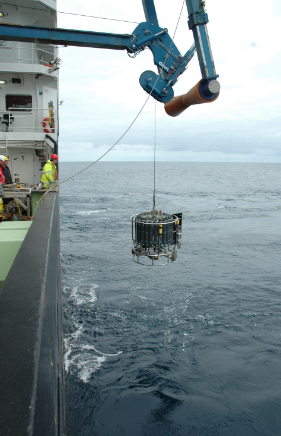
Our first activity at 'Middle of What' is a CTD yo-yo deployment. The CTD is the instrument that measures conductivity (salinity), temperature and depth (pressure). And ‘yo-yo deployment’ means that we are going to put it deep down, close to the seabed, and back near the surface and deep down again and so on … for 13 hours! Another instrument (called an ADCP) which is able to measure the speed of the currents is tied to the CTD frame.
Thanks to these accurate instruments we will collect a large amount of data. Jane, the physical oceanographer on board, will then be able to differentiate the water masses (layers of water with their own characteristics), assess the variability of the water column (structure of the layers), she will be able to compile the whole water column current velocities and see what tidal effects there are around the seamount, such as internal waves. Tides can have a strong impact on the small biota (fauna and flora) both at the sea surface and at the seabed.
You can divide oceanography - ocean sciences - into three parts: the biological oceanography (the part that studies life in the oceans, the patterns of distribution and abundance of species such as the variability of algae bloom, etc.), the chemical oceanography (that surveys how much CO2 is dissolved in the oceans, iron, traces, etc.) and the physical oceanography (the part that explores currents, the formation of water masses and their characteristics, warming of the global ocean, etc.).
The ocean is a 3D fluid environment where movement can be sidewards AND up & down. This is not straightforward for us human beings who live most of our day-to-day life (with the exception of scuba diving and flying in an aeroplane) across a 2D static surface.
Thanks to these accurate instruments we will collect a large amount of data. Jane, the physical oceanographer on board, will then be able to differentiate the water masses (layers of water with their own characteristics), assess the variability of the water column (structure of the layers), she will be able to compile the whole water column current velocities and see what tidal effects there are around the seamount, such as internal waves. Tides can have a strong impact on the small biota (fauna and flora) both at the sea surface and at the seabed.
Tuesday, November 29, 2011
The men (and woman) in charge
There are 22 crew members on board the RRS James Cook on this cruise. The most important thing you have to know is that THEY are running the ship. We are their guests.
The crew includes the four people working in the galley - Chris, Wally, Graham and Roger - who prepare excellent food for us 3 times a day. Then we have Anthony who is responsible for everything related to administration on board, ordering stores and interactions with local authorities in every port. He is the shopkeeper as well (the shop is a cluttered room where everyone on board can buy T-Shirts, chocolate, toothpaste, and sweets, and did I mention chocolate, three times a week).
At the bridge we have the Chief Officer (Richard), the Second Officer (Michael) and the 3rd Officer (Amy – only female crew member and on her first cruise on board the RRS James Cook!) who are sailing the ship.
Everything that functions 24/7 on board such as the engines, air conditioning, water, electricity, is provided thanks to a very dedicated engineer team – Bob, Chris, Ian, Innes, James and David.
Mick and Andy are responsible for loading of the equipment and everything that has to be moved from one part of the ship to another, for example.
Then we have Dave, Ian, Kenneth, Peter and Will who are providing support regarding the deployment and recovery of every scientific instrument.
And last but not least, we have Bill, the captain of the RRS James Cook, in charge of everyone and everything happening on board this vessel.
The crew usually spend a total of 6 months a year at sea generally for periods of 2 months maximum but it can go up to 10-12 weeks.
They have had a diverse range of experience before joining this research vessel … and their image of scientists is kind of clichéd like "they all look like Jesus Christ and wear sandals with socks" (which is not always wrong) but on the other hand they like the scientists' enthusiasm and love to learn new things every time new experiments are conducted on board. It is nice for them to have a different group of people of various ages on each cruise (PhD students to senior scientists).
And it makes it interesting for them when we make new discoveries on board their ship!
Bill adds that "It is even nicer if they laugh at my jokes." And, he admits that the crew are always amused when the scientists get seasick.
The crew includes the four people working in the galley - Chris, Wally, Graham and Roger - who prepare excellent food for us 3 times a day. Then we have Anthony who is responsible for everything related to administration on board, ordering stores and interactions with local authorities in every port. He is the shopkeeper as well (the shop is a cluttered room where everyone on board can buy T-Shirts, chocolate, toothpaste, and sweets, and did I mention chocolate, three times a week).
At the bridge we have the Chief Officer (Richard), the Second Officer (Michael) and the 3rd Officer (Amy – only female crew member and on her first cruise on board the RRS James Cook!) who are sailing the ship.
Everything that functions 24/7 on board such as the engines, air conditioning, water, electricity, is provided thanks to a very dedicated engineer team – Bob, Chris, Ian, Innes, James and David.
Mick and Andy are responsible for loading of the equipment and everything that has to be moved from one part of the ship to another, for example.
Then we have Dave, Ian, Kenneth, Peter and Will who are providing support regarding the deployment and recovery of every scientific instrument.
And last but not least, we have Bill, the captain of the RRS James Cook, in charge of everyone and everything happening on board this vessel.
The crew usually spend a total of 6 months a year at sea generally for periods of 2 months maximum but it can go up to 10-12 weeks.
They have had a diverse range of experience before joining this research vessel … and their image of scientists is kind of clichéd like "they all look like Jesus Christ and wear sandals with socks" (which is not always wrong) but on the other hand they like the scientists' enthusiasm and love to learn new things every time new experiments are conducted on board. It is nice for them to have a different group of people of various ages on each cruise (PhD students to senior scientists).
And it makes it interesting for them when we make new discoveries on board their ship!
Bill adds that "It is even nicer if they laugh at my jokes." And, he admits that the crew are always amused when the scientists get seasick.
Monday, November 28, 2011
Quote of the day
"Man cannot discover new oceans unless he has the courage to lose sight of the shore."
André Gide
[1869-1951]
Sunday, November 27, 2011
Have you heard about hydrothermal vents?
Research on seamounts will pause as another science project will divert our expedition cruise for the next 3 days. It will focus on hydrothermal vents.
Hydrothermal vents are another special feature of the deep-ocean. They mostly occur on mid-ocean ridges (long, narrow, natural elevations on the floor of the ocean where oceanic crust is formed). The one Leigh and Jon are going to explore - and sample for the very first time - is located on the Southwest Indian Ocean Ridge at 2800m depth.
Chimneys, formed on hydrothermal vent fields, release hot fluid filled with chemicals from the inside of the Earth. Hydrothermal vents support very specific fauna. Communities that developed in these very deep sea habitats use the chemical energy of the vent fluid to live and thrive.
The hydrothermal vent area will be investigated through several ROV dives in order to take HD images of the whole structure and characterize the composition of the vent fauna.
An additional blog is in place for this other research project for the next few days; you will find more info about what is going on on board the RRS James Cook regarding hydrothermal vents here:
http://www.thesearethevoyages.net/jc67/index.html
Hydrothermal vents are another special feature of the deep-ocean. They mostly occur on mid-ocean ridges (long, narrow, natural elevations on the floor of the ocean where oceanic crust is formed). The one Leigh and Jon are going to explore - and sample for the very first time - is located on the Southwest Indian Ocean Ridge at 2800m depth.
Chimneys, formed on hydrothermal vent fields, release hot fluid filled with chemicals from the inside of the Earth. Hydrothermal vents support very specific fauna. Communities that developed in these very deep sea habitats use the chemical energy of the vent fluid to live and thrive.
The hydrothermal vent area will be investigated through several ROV dives in order to take HD images of the whole structure and characterize the composition of the vent fauna.
An additional blog is in place for this other research project for the next few days; you will find more info about what is going on on board the RRS James Cook regarding hydrothermal vents here:
http://www.thesearethevoyages.net/jc67/index.html
| ROV screens during the first dive on the vent field |
| Hydrothermal vent; ROV images |
Saturday, November 26, 2011
Far reaching human impact
Today is our last day at Melville bank. So what have we discovered?
Melville bank painted a very different picture to that of Coral seamount. We found that incredibly this area, despite being thousands of miles out into the ocean, has been heavily exploited by the fishing industry. Unlike Coral seamount, a large area of Melville bank has clearly been fished. We found most places covered only by dead coral rubble. We could see what damage deep-sea trawling can do to the seabed. It literally destroys everything. However, even on such a heavily exploited seamount there were areas that were rich with life. This was because the terrain was so rugged that mobile fishing gear could not be used.
Throughout our exploration of Melville bank we have come across evidence of human impact. We saw many lost lobster pots, drifting pieces of fishing long lines, broken trawl wires and even rubbish (mainly bottles). All these pieces of equipment were floating around on the seabed as ghosts.
It was always impressive and frightening to see this gear appearing on the ROV screens in the devastated landscape of the seamount and caused us a great deal of difficulty in completing our research dives.
Melville bank painted a very different picture to that of Coral seamount. We found that incredibly this area, despite being thousands of miles out into the ocean, has been heavily exploited by the fishing industry. Unlike Coral seamount, a large area of Melville bank has clearly been fished. We found most places covered only by dead coral rubble. We could see what damage deep-sea trawling can do to the seabed. It literally destroys everything. However, even on such a heavily exploited seamount there were areas that were rich with life. This was because the terrain was so rugged that mobile fishing gear could not be used.
Throughout our exploration of Melville bank we have come across evidence of human impact. We saw many lost lobster pots, drifting pieces of fishing long lines, broken trawl wires and even rubbish (mainly bottles). All these pieces of equipment were floating around on the seabed as ghosts.
It was always impressive and frightening to see this gear appearing on the ROV screens in the devastated landscape of the seamount and caused us a great deal of difficulty in completing our research dives.
| Sky at sunrise 5:15 am (ship time) |
Friday, November 25, 2011
Digging in the seabed for very very small animals
We have 6 people on board whose main scientific interest lies in sediments, or more exactly, in what animals you can find in the sediments.
Sediment is matter that has been deposited by some natural process on the seafloor. It can consist of mud, sand, gravels and pebbles and it may harbour high biodiversity. Its inhabitants range in size from a few millimetres to 45 micrometres (=0.045 millimetres) and are mainly tiny worms, crustaceans (like shrimps) and molluscs (like mussels).
There are different ways to collect sediments. Usually you core sample with a transparent plastic tube that you drive into the seabed which allows you to see the different layers.
In the vicinity of seamounts, the seabed is either too hard or sediments are too coarse to stay in the coring tube and we have had some unfortunate attempts.
We are now using the robot HYBIS and its big jaw to grab a pile of sediments which makes our 6 people – Natalia, Adam, Tim, Peter, Margaret and Lucy - very happy!
In these areas sediments contain organic debris such as dead corals, shell fragments and plankton remains. Sediments on the seabed might not look as attractive as other marine habitats but if you look closer …. closer …. closer …… you can see amazing forms of life!
Sediment is matter that has been deposited by some natural process on the seafloor. It can consist of mud, sand, gravels and pebbles and it may harbour high biodiversity. Its inhabitants range in size from a few millimetres to 45 micrometres (=0.045 millimetres) and are mainly tiny worms, crustaceans (like shrimps) and molluscs (like mussels).
There are different ways to collect sediments. Usually you core sample with a transparent plastic tube that you drive into the seabed which allows you to see the different layers.
In the vicinity of seamounts, the seabed is either too hard or sediments are too coarse to stay in the coring tube and we have had some unfortunate attempts.
We are now using the robot HYBIS and its big jaw to grab a pile of sediments which makes our 6 people – Natalia, Adam, Tim, Peter, Margaret and Lucy - very happy!
| Polychaete (0.5 mm wide) © P. Lamont |
Crustacean (2 mm) © P. Lamont |
Thursday, November 24, 2011
Surprisingly colourful
| Brisingid (sea star) |
I was wrong! From the bright red urchins to pale green, yellow, orange, red and purple corals, this place is full of different colours!
We saw small bright pink crabs, pink lobsters, snow-white and orange sea stars and … fish in disguise!
| Centriscops humerosus |
We met this funny looking fish during our ROV dives at Melville. It is a banded yellowfish ... real name Centriscops humerosus.
It is from the same group of fish as sea horses. Any resemblance?
| Centriscops humerosus |
We can find it at this range of latitude all around the southern hemisphere (Southeast Atlantic: South Africa; Southwest Atlantic: Argentina. Southwest pacific: Australia and New Zealand). Its depth range is usually 450 – 700m.
| Octocorals |
| Unknown octocoral with brittlestar |
| Anthomastus sp. (coral) |
| Lepidion sp. |
Wednesday, November 23, 2011
The escape of the lobster or how it is not always possible to steal the secrets from the deep
During our first ROV dive at Melville bank this morning, there was a suspenseful moment or two when the robot tried to capture a very cunning 20cm-long lobster.
After some unsuccessful trials, we managed to get it into the collecting net but as we were trying to put the net into the bio box, it jumped out of the net and landed on the ROV.
Then we tried our best to have it fall into the box by creating some currents with the thrusters in its direction.
And … it worked. It was in the box!
All we had to do was to put the net with the sediments on the lobster and close the box.
But things are not so straightforward at 900m depth. And our very brave lobster, gathering its strength, jumped and swam out of the 30cm deep box!
We will never know what species it was! For now it will remain a mystery of the deep ...
Tuesday, November 22, 2011
Coral and critters
By Michelle Taylor, Post-doctoral Researcher, University of Oxford
The words ‘coral reef’ conjure up mental images of tropical sandy beaches, cocktails and colourful fish. For me however they conjure up images of long oceanic voyages (sea sickness tablets), large pieces of deep-sea sampling equipment and all manner of colourful animals (Nemo doesn’t have a patch on these guys…). You see, corals are not confined to the shallow warm sections of this planet; they in fact occur in every Ocean, even the very coldest, and have been found thousands of metres down where the water is anything but tropical. Deep-sea corals exist by filter feeding from the water around them. As such, they need to be in areas of strong currents. They also need a solid base to grow on making seamounts ideal locations.
There are just a handful of hard skeleton deep-sea coral species that grow into large reef frameworks. When this does happen these reefs are a sight to behold; even the small areas seen so far on this expedition have been home to a bewildering array of animals. We have seen baby-pink lobsters (whose abodes are immediately filled by another once one is sampled), the tiniest yellow sea spiders, intense-red anemones, flame orange fish and electric purple octocorals (who are unusually always home to the same big snake-armed brittlestar species).
In general, the deep sea of the Indian Ocean is very understudied, certainly one of the least studied regions for deep-sea corals globally, making discoveries to be made on this expedition very important and very interesting indeed.
The words ‘coral reef’ conjure up mental images of tropical sandy beaches, cocktails and colourful fish. For me however they conjure up images of long oceanic voyages (sea sickness tablets), large pieces of deep-sea sampling equipment and all manner of colourful animals (Nemo doesn’t have a patch on these guys…). You see, corals are not confined to the shallow warm sections of this planet; they in fact occur in every Ocean, even the very coldest, and have been found thousands of metres down where the water is anything but tropical. Deep-sea corals exist by filter feeding from the water around them. As such, they need to be in areas of strong currents. They also need a solid base to grow on making seamounts ideal locations.
There are just a handful of hard skeleton deep-sea coral species that grow into large reef frameworks. When this does happen these reefs are a sight to behold; even the small areas seen so far on this expedition have been home to a bewildering array of animals. We have seen baby-pink lobsters (whose abodes are immediately filled by another once one is sampled), the tiniest yellow sea spiders, intense-red anemones, flame orange fish and electric purple octocorals (who are unusually always home to the same big snake-armed brittlestar species).
In general, the deep sea of the Indian Ocean is very understudied, certainly one of the least studied regions for deep-sea corals globally, making discoveries to be made on this expedition very important and very interesting indeed.
| ROV images; Coral seamount; Isididae sp. - unknown, next to some bottlebrush octocoral |
| ROV images; Coral seamount; Isididae sp. - unknown bamboo coral with Galatheid crab and brittlestars |
Monday, November 21, 2011
Steaming for Melville
We left Coral seamount yesterday evening after the mooring recovery and we have just arrived at the second site: Melville bank.

We are going to stay a few days in this area to explore the site, mainly conducting the same surveys as on Coral seamount (CTD transect, ROV and other robot dives, coring, bathymetric survey, etc.). We'll do our best to collect as much information as possible about this site. It will be very interesting to compare our results knowing that this seamount is in warmer waters than Coral seamount. Seawater temperature at the surface is now around 17°C (that’s a 7 degree rise overnight)!
Sunday, November 20, 2011
Hunting for a package of whale bones
Two years ago during the previous cruise, two moorings, each carrying a package of whale bones and a package of mango wood logs, were placed on the seabed at Coral seamount and Atlantis bank. They are attached to a vertical line with floats at one end and 150kg of ballast at the other end.
The idea is to study the life that will settle on these new substrates and identify what organisms (worms) will grow while the bacteria that colonize the bones and wood during their decomposition recreate a similar chemical environment to those found at hydrothermal vents and cold seeps (both special deep-sea habitats).
We will hopefully be able to analyse the variety and distribution of the worms associated with these environmental conditions.
Slow growing and slow recovery are typical features of the deep-sea communities. If we learn more about this process through experiments like this, it will help us to understand how marine ecosystems are connected and determine the best strategies for protecting these deep-sea habitats.
We spotted the first mooring four days ago during one of the ROV dives at Coral seamount and today we dived again at the same location to try and recover them at 743m depth.
And we were successful!


The idea is to study the life that will settle on these new substrates and identify what organisms (worms) will grow while the bacteria that colonize the bones and wood during their decomposition recreate a similar chemical environment to those found at hydrothermal vents and cold seeps (both special deep-sea habitats).
We will hopefully be able to analyse the variety and distribution of the worms associated with these environmental conditions.
Slow growing and slow recovery are typical features of the deep-sea communities. If we learn more about this process through experiments like this, it will help us to understand how marine ecosystems are connected and determine the best strategies for protecting these deep-sea habitats.
We spotted the first mooring four days ago during one of the ROV dives at Coral seamount and today we dived again at the same location to try and recover them at 743m depth.
And we were successful!
Saturday, November 19, 2011
James Cook vs mysteries of the deep (1-0)
We have been around Coral seamount for a week now. It’s time to have a look at what's been done already. We have had an impressive number of events: 1 wire test, 1 test of acoustic interferences between instruments, 4 ROV Kiel6000 dives (see Remotely Operated Vehicle blog post), 3 SHRIMP dives, 2 HYBIS dives, 8 CTD (see CTD and Anni’s microbes), 1 ring net deployment (see Clare and the Jellyfish), 1 microprofiler (mixing; see Overnight work), 6 boxcorer deployments and 7 megacorer deployments to collect sediments (see upcoming blog posts...), 1 multibeam survey (see How to map the seafloor), a lot of seawater collected and filtered, a lot of organisms and samples labelled and preserved. We have still not unlocked all the mysteries of Coral seamount though. Over the last few days the weather has frustrated our progress and we are yet to see what lives on the top of the seamount. So tonight and tomorrow we will attempt to tow SHRIMP, our towed camera system, up the upper slopes and onto the summit where we have seen a strange hole in the top of the seamount with the echosounders..........
We've been happy to see many fur seals, 2 Sperm whales, hundreds of albatrosses, white-chinned petrels, cape petrels, terns, prions and other seabirds.
Air temperature (daytime) range: 7 and 13°C.
Seawater temperature: around 10°C at the surface, 4°C at the seafloor
Area covered (latitude, longitude): [41°20’:41°28’] South, [42°50’:42°57’] East
We've been happy to see many fur seals, 2 Sperm whales, hundreds of albatrosses, white-chinned petrels, cape petrels, terns, prions and other seabirds.
Air temperature (daytime) range: 7 and 13°C.
Seawater temperature: around 10°C at the surface, 4°C at the seafloor
Area covered (latitude, longitude): [41°20’:41°28’] South, [42°50’:42°57’] East
© L. Rolley |
© L. Rolley |
© L. Rolley |
Friday, November 18, 2011
Anni's microbes
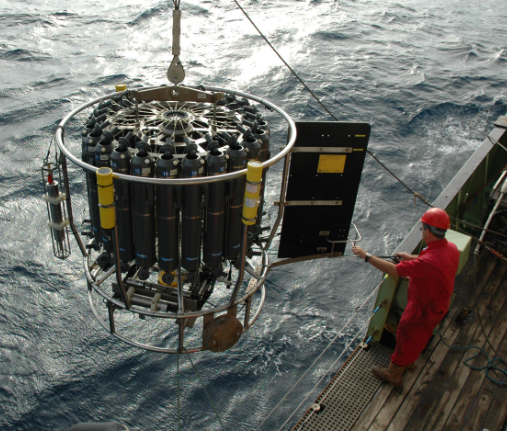
The weather calmed down during the night and work could resume. We did a CTD transect above the Coral seamounts area. CTD stands for Conductivity Temperature Depth. It goes along with a Rosette of 24 Niskin bottles, each one of those can be closed at a chosen depth.
It allows you to bring back on board bottles of seawater collected all the way from the bottom to the surface at any depths you choose.
The instrument itself gives you the salinity (conductivity) and the temperature at each depth. Nowadays other parameters have been added as, for example, oxygen.
With all this information you can distinguish different layers (water masses) and get a pretty good idea of the origin of the seawater at this depth.

Anni, a student from Oxford University, is very interested in microbes. Seawater is full of microbes quite different than the ones we have on land. Anni filtered the seawater from the Niskin bottles to see what species of microbes she will find after a DNA analysis. Did you know that we can find up to 1 million bacteria per millilitre in seawater?!
It allows you to bring back on board bottles of seawater collected all the way from the bottom to the surface at any depths you choose.
The instrument itself gives you the salinity (conductivity) and the temperature at each depth. Nowadays other parameters have been added as, for example, oxygen.
With all this information you can distinguish different layers (water masses) and get a pretty good idea of the origin of the seawater at this depth.
Anni, a student from Oxford University, is very interested in microbes. Seawater is full of microbes quite different than the ones we have on land. Anni filtered the seawater from the Niskin bottles to see what species of microbes she will find after a DNA analysis. Did you know that we can find up to 1 million bacteria per millilitre in seawater?!
Subscribe to:
Posts (Atom)